Modern deep learning systems can outperform humans on tasks that once looked completely out of reach. They classify images at scale, reason over long contexts, support scientific discovery, and drive perception stacks in complex environments. Yet that apparent competence hides a deeply uncomfortable fact: the same systems can be pushed into catastrophic failure by changes that are almost invisible to us.
That tension is the real starting point for adversarial robustness. The problem is not that models make occasional mistakes. The problem is that very capable models can make high-confidence mistakes under perturbations so small that a human observer would not even notice them. Once that happens, robustness stops being an academic detail and becomes a question of whether we can trust a model at all.
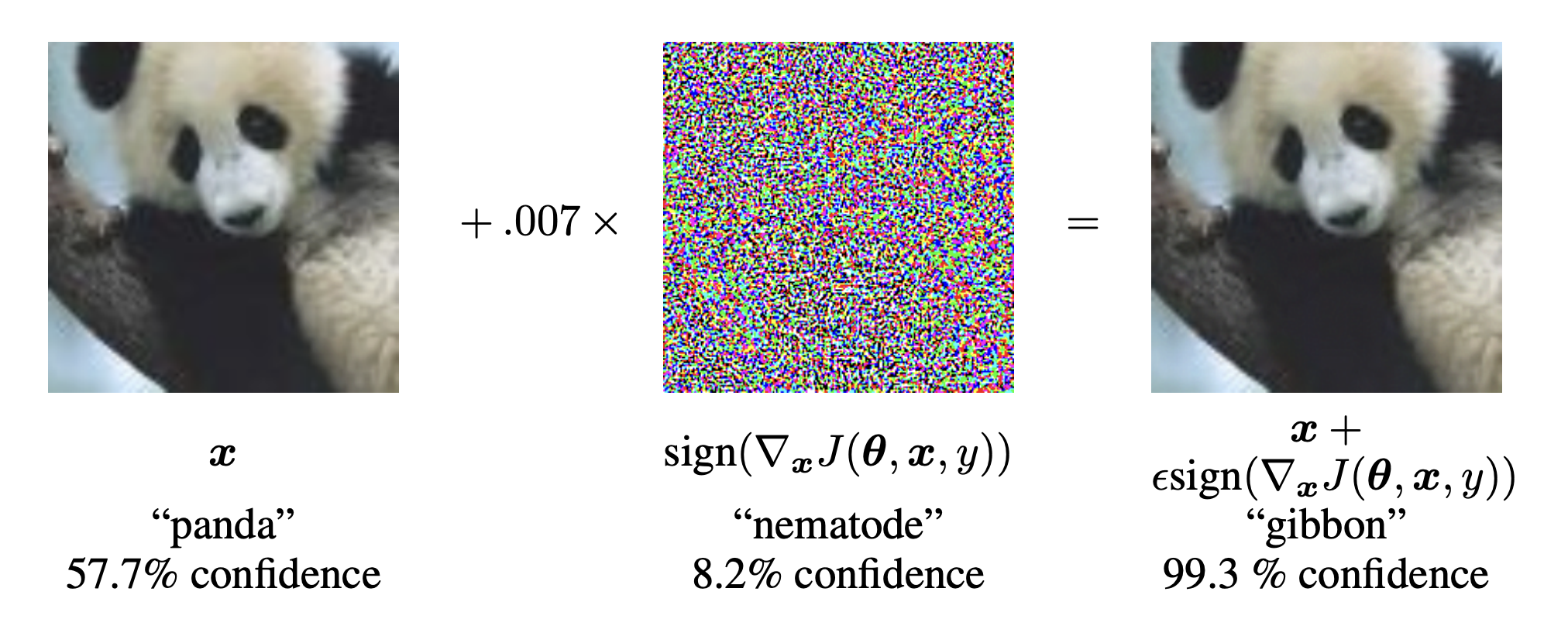
A classic adversarial example. A tiny, carefully designed perturbation causes the model to classify a panda as a gibbon with very high confidence. Image source: (Goodfellow et al., 2015)
The panda-to-gibbon example remains the clearest illustration. A clean image is classified correctly. Add a perturbation that is barely perceptible, and the prediction flips with confidence. The key point is that the perturbation is not random visual noise. It is optimized using the model’s own gradients to push the classifier toward failure. In other words, the attack exploits how the model actually organizes its decision boundary.
Once we look at the problem through that lens, the stakes become obvious. If a model can be manipulated so easily, what should we expect in settings where errors are costly?
- In autonomous driving, a failure in perception can corrupt downstream planning.
- In medical imaging, a brittle decision boundary can turn a minor input shift into a dangerous diagnosis error.
- In finance or risk screening, a high-confidence mistake can become an automated operational error.
The uncomfortable conclusion is that benchmark strength does not imply deployment trustworthiness. A system can be excellent on average and still be dangerously fragile in the worst case.
This is why adversarial robustness matters. It asks a sharper question than standard accuracy: how stable is a model when the input is pushed, manipulated, or shifted in ways that matter? That question matters because the world does not present inputs in a clean, static, benchmark-style form.
The research community has treated this as an ongoing arms race. As soon as one class of attacks becomes familiar, more adaptive or more realistic attacks follow. Defenses improve, but attacks also become stronger, broader, and less artificial.

The arms race in adversarial machine learning. Robustness research evolves as attacks and defenses push against each other over time.
That dynamic is why a single “fix” is never the whole story. Robustness is not one trick, one paper, or one benchmark. It is an attempt to understand where models are structurally vulnerable, what kinds of perturbations actually matter, and which defenses meaningfully change the picture.
This series follows that path in order. First, we clarify what robustness really means beyond intuition. Then we look at how the threat model evolved, how defenses are organized, and why robustness becomes even harder when we move into modern architectures and high-stakes applications.